
Denmark received international recognition in 2023 when the government became the first in the world to launch an official Action Plan for Plant-Based Foods. The plan stems from a broadly supported agreement in the Danish Parliament. In addition, Denmark has allocated 1.3 billion DKK to strengthen the production and consumption of plant-based foods as part of a greener, healthier, and more climate-friendly food sector.
This attention to Denmark’s efforts has prompted several Danish organisations to join forces to share these experiences with the rest of the EU through the initiative Danish Plant-Based Diplomacy.
The initiative is being launched by The Danish Food and Drink Federation (DI Fødevarer), the Danish Chamber of Commerce, the Organic Denmark Association, the Danish Agriculture & Food Council, the think tank Frej, the youth organisation LandboUngdom, the Danish Plant-Based Business Association, and the Vegetarian Society of Denmark. The goal is to inspire the European Commission, the European Parliament, and member states to pursue ambitious political action, building on the Danish action plan and its accompanying funding.
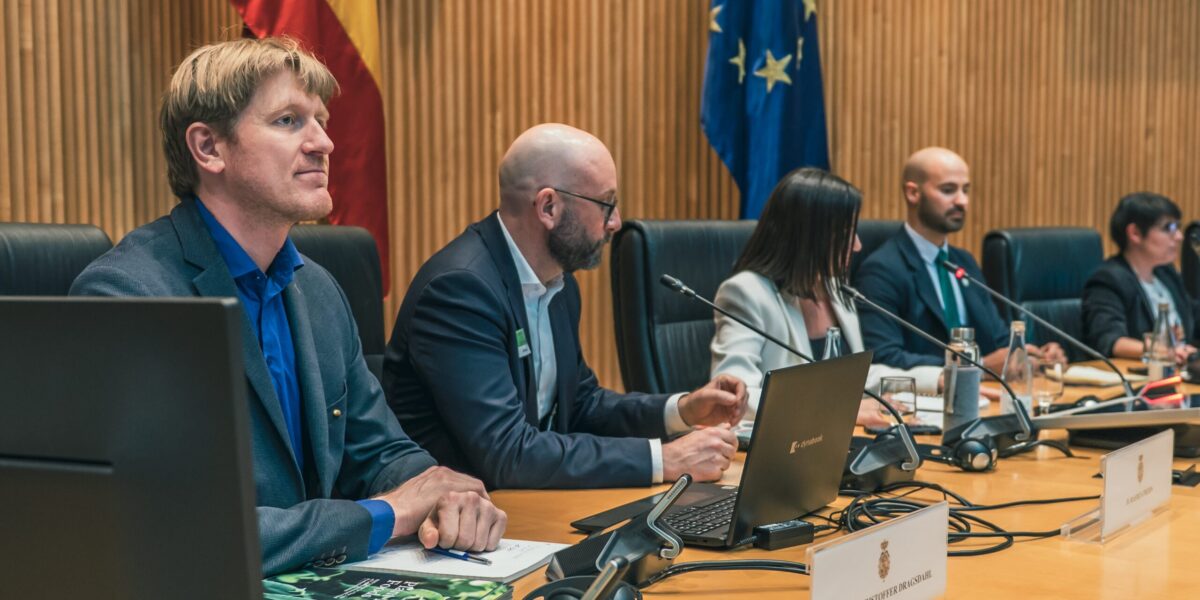
According to Rune-Christoffer Dragsdahl, Secretary General of the Vegetarian Society of Denmark and newly appointed Chair of the International Vegetarian Union, Denmark has already shown that a plant-based transition is both possible and politically viable:
“Denmark has demonstrated that a plant-based transition is not only possible but also a political success, backed by both the agricultural and industrial sectors. With Danish Plant-Based Diplomacy, we want to share the Danish experience so the rest of the EU is inspired to develop similar initiatives that benefit the climate, biodiversity, and public health,” says Rune-Christoffer Dragsdahl, Secretary General of the Vegetarian Society of Denmark and newly appointed Chair of the International Vegetarian Union.
Concrete results and collaboration
Denmark has already implemented a number of concrete initiatives – including updated dietary guidelines that combine health and climate considerations and are partly inspired by the EAT-Lancet Commission’s planetary health diet, which highlights the need for significantly more plant-based food. These are supplemented by support for plant-based startups, incentives for farmers, and continuing education for professional kitchen staff. These are precisely the kinds of experiences the initiative aims to share with European decision-makers.
The think tank Frej also sees Denmark as a frontrunner – not least because both politicians and businesses are taking responsibility in promoting plant proteins:
“Denmark has a large animal-based production and consumption sector. Nevertheless, we have courageous politicians and courageous companies – including those in animal agriculture – who dare to invest in promoting plant proteins. This is essential if we are to achieve a more diverse protein supply in Denmark and across the EU. It is a matter of food security, public health, and planetary well-being,” says Marie-Louise Boisen Lendal, Director of Frej.
Results through cross-border dialogue
Danish Plant-Based Diplomacy will actively promote dialogue across Europe, with a particular focus on sending small Danish delegations to parliaments and embassies, as well as participating in networking events and roundtable discussions.
The partnership is not only about putting more plant-based food on plates – it also aims to address the entire value chain from farm to fork. Organic farming plays a central role in this, notes Organic Denmark:
“In organic farming, all animals must be allowed outside, have more space, and enjoy good living conditions. That means our food culture – in Denmark and across the Western world – must become much more plant-rich if agriculture is to fulfil organic goals and principles. We are therefore pleased to be part of this initiative,” says Michael Kjerkegaard, Chair of Organic Denmark.
Opening up new business opportunities
The organisations behind the initiative also see strong economic opportunities in strengthening plant-based food production and making it part of Europe’s economic future. The Danish Chamber of Commerce already sees growing demand – among both consumers and businesses:
“At the Danish Chamber of Commerce, we want to help create the conditions that enable consumers to choose from a wide variety of foods – including more plant-based options – whether they’re shopping or dining out. At the same time, we hear from many of our members that they want to focus more on meat-free products than they currently do. That’s why it’s only natural for us to support the Plant-Based Diplomacy initiative and help increase interest in and demand for plant-based foods across the EU,” says Saoirse McKeever Andersen, Head of Food Policy at the Danish Chamber of Commerce.
Young farmers are also supportive. For them, it’s not just about food – it’s about the future, and the possibility of building new business opportunities through political change:
“It is young farmers who must produce the food of the future – including plant-based food. That’s why initiatives like Plant-Based Diplomacy are so important in promoting EU policies that can enable and support this development. These policies will create business opportunities and the right framework for us to help shape the future of food. If we don’t succeed in this, we’ll be left with great ambitions but no one to realise them,” says Christian Orthmann, Chair of LandboUngdom.
Development and innovation with EU support
The food industry is already innovating new plant-based products – but the potential is far from exhausted. The Danish Food and Drink Federation (DI Fødevarer) sees this initiative as a lever to accelerate the transition:
“Many innovative food companies – large and small – are developing new production methods and tasty plant-based products and ingredients that benefit both consumers and the green transition in Denmark. But we need to scale up and speed up the production of plant-based food. To ensure sustainable development and business, we must look beyond Denmark’s borders and work together across Europe. Plant-Based Diplomacy can help pave the way,” says Jakob Lave, Director of The Danish Food and Drink Federation (DI Fødevarer).
The Danish Agriculture & Food Council also backs the initiative – and emphasises that plant-based and animal-based production are not in opposition, but must evolve together:
“We see Danish Plant-Based Diplomacy as a strong platform for developing plant-based production while also supporting the continued green transition of animal-based agriculture. In a world where demand for nutritious and sustainably produced food is growing, this is not a matter of either-or, but of both-and,” says Christian Høegh-Andersen, Vice Chair of the Danish Agriculture & Food Council.
The Danish Plant-Based Business Association emphasises that Denmark has already proven how targeted government support and political commitment can produce real results – and that other EU countries should take note:
“At the Plant-Based Business Association, we see an urgent need for joint political action in the EU to promote plant-based solutions for the benefit of climate, health, and agriculture. As a trade association representing companies developing and producing the plant-based foods of the future, we clearly see how political initiatives and targeted business support can generate growth and innovation in the sector. The Danish action plan and the state fund of DKK 1.3 billion have given our members a significant boost – support we would also like to see across the rest of Europe. We stand ready to share our experiences and actively contribute to the European dialogue so that more countries can accelerate the shift toward a more plant-based food system,” says Stella Staunstrup, Secretary General of the Plant-Based Business Association.
Facts:
The Plant-Based Fund:
DKK 1.3 billion in support (2023–2030) across the entire value chain – from farm to fork. The funding originates from the 2021 Agricultural Agreement, the 2024 Green Tripartite Agreement, the Green Fund, and annual research agreements.
The organisations behind Danish Plant-Based Diplomacy:
– Danish Chamber of Commerce (Dansk Erhverv)
– The Danish Food and Drink Federation (DI Fødevarer)
– Organic Denmark
– Danish Agriculture & Food Council
– Think Tank Frej
– LandboUngdom
– Plant-Based Business Association (Plantebranchen)
– Vegetarian Society of Denmark